Turn a Valentine Card into a Woven Heart Pocket

The front of this Valentine looks like a checkerboard, but the woven heart opens from the top. Slip a folded note inside and hand it over as a card. The trick is to weave through folded loops rather than treating the strips as single layers.
Make two matching blanks
- Two contrasting 6 by 18 cm rectangles of lightweight colored paper
- Ruler, pencil, scissors and an optional scrap of paper for the note
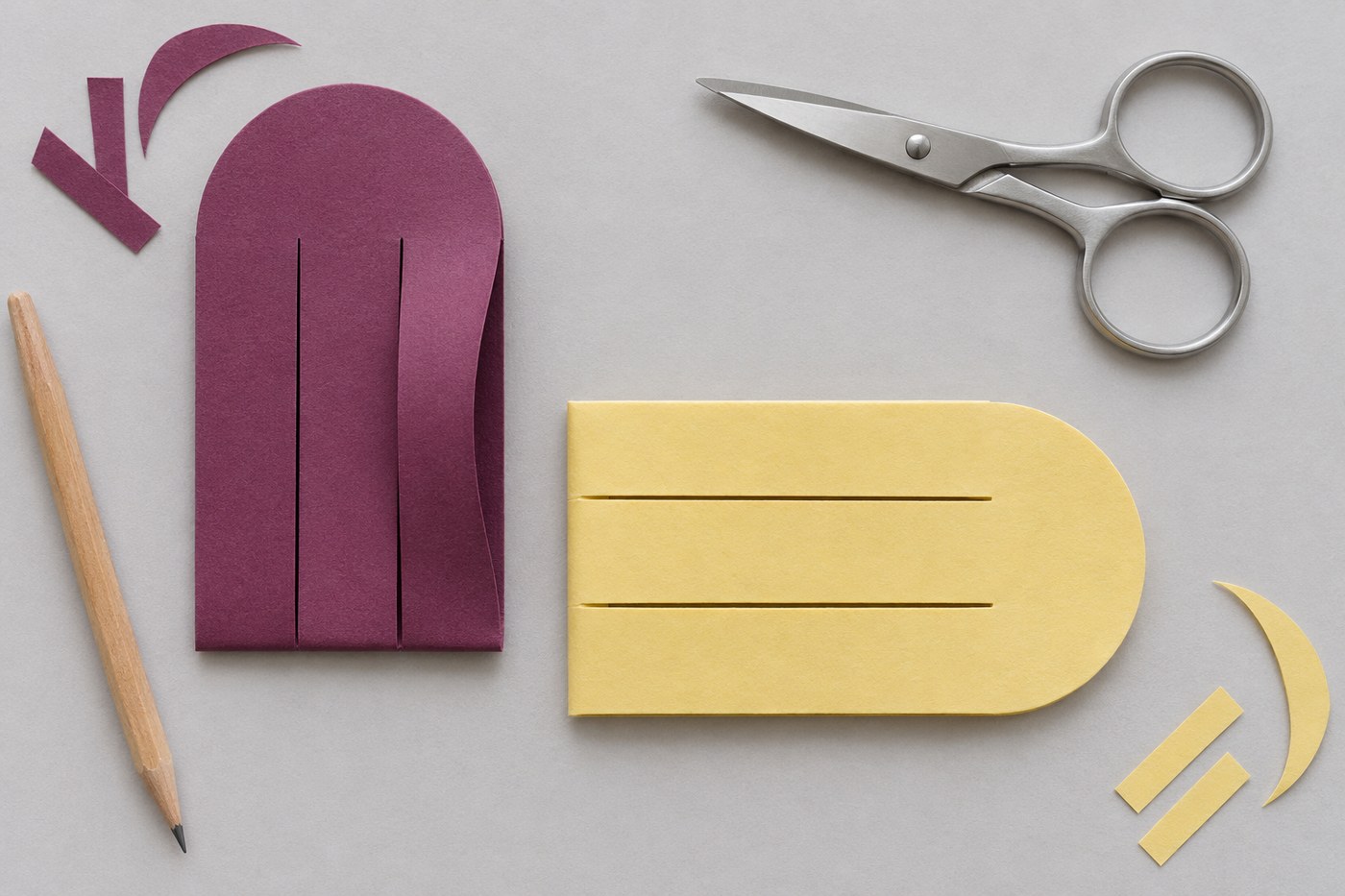
Fold each rectangle end to end to make a 6 by 9 cm blank. With the fold nearest you, mark a line 6 cm up from the fold. Draw a semicircle above that line, with its highest point at the middle of the open edge. Cut along the curve through both layers, leaving the sides straight below the 6 cm line. The rounded ends become the two lobes of the heart.
Divide the folded edge into three 2 cm sections. From that edge, cut through both layers at the two marks, stopping about 2 mm beyond the 6 cm line. Do not cut across the strip ends: you need three closed loops per blank.
Weave through, then around
- Hold one blank with its loops pointing right and the other with its loops pointing down. Open the first horizontal loop slightly and feed it through the first vertical loop.
- For the second intersection, open that same horizontal loop and slip it around the second vertical loop. Pass it through the third vertical loop.
- Work the next horizontal loop in the opposite order: around, through, around. Weave the last loop like the first. Slide the paper gently into position after each row instead of yanking on the ends.
Check that it opens
Separate the two rounded layers at the top and slip a finger into the pocket. If they will not part, check for a loop that went over only one layer instead of all the way through. If the third row binds, unweave it and extend the slits a millimeter at a time. Tuck in a note folded smaller than the opening so it does not strain the paper.