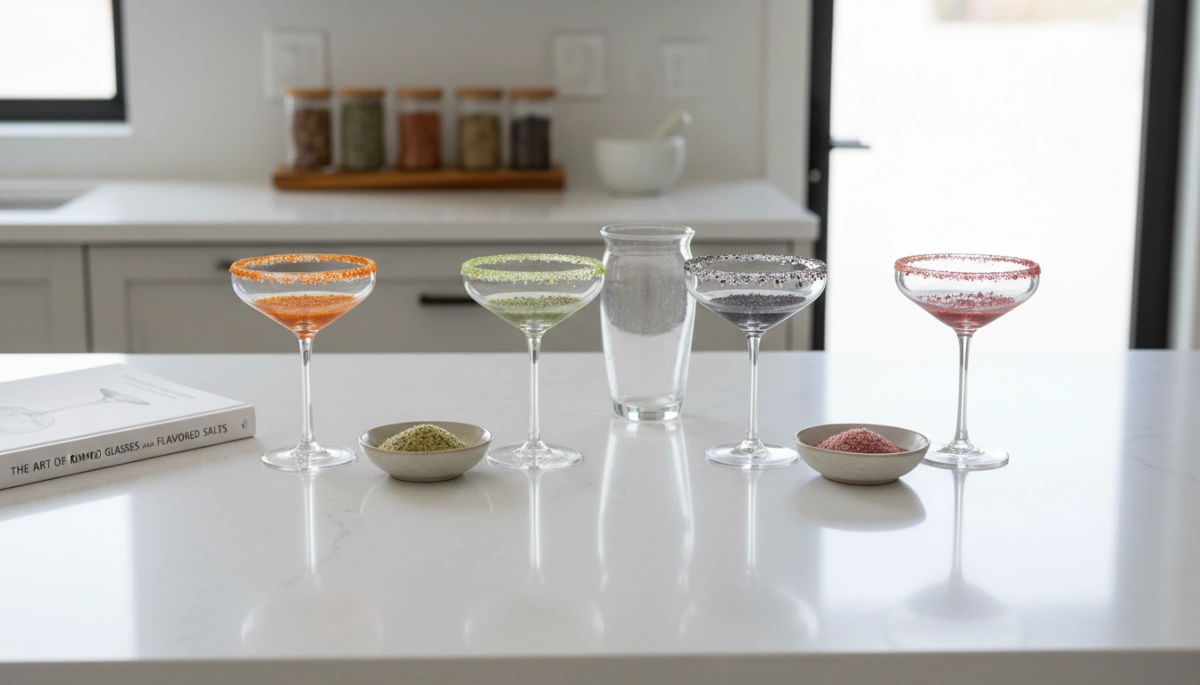
The Art of Rimmed Glasses and Flavored Salts Guide for Perfect Cocktails

A rimmed glass is not decoration. It’s the first ingredient your lips touch before the cocktail ever reaches your tongue — which means a badly executed rim can tank an otherwise excellent drink. Get it right, and a simple recipe becomes something guests actually remember.
Why the Rim Changes the Flavor of Your Cocktail
The rim functions as a flavor bridge. Every sip passes through it. Salt suppresses bitterness and amplifies sweetness — which is exactly why a salted Margarita tastes rounder and more complete than an unsalted one. Sugar rims slow the perception of alcohol heat. A chili rim adds slow-building warmth that follows the citrus down the back of your throat long after you’ve swallowed.
This isn’t folklore. Salt ions bind to bitter taste receptors, blocking them from firing at full intensity. The result is a drink that reads as sweeter and more balanced — even though nothing in the liquid itself has changed.
The proportional impact is larger than most people assume. A standard 10-oz rocks glass with a 1/4-inch rim introduces real flavor with every sip. Over a full drink, that accumulates. Which is why your material ratio matters enormously — at 100% kosher salt, the rim is sharp and mineral. At 60% salt / 40% sugar, the profile softens entirely. The blend is a recipe, not an afterthought.
When to Skip the Rim Entirely
Some cocktails suffer from a rim. A Negroni is already precisely balanced — adding salt disrupts the bitter-sweet equilibrium the drink was built around. Same with a classic Martini, or anything leaning heavily on amaro or aged vermouth. The rim is a tool for cocktails that need contrast: citrus-forward sours, highballs, and builds where an additional flavor layer at the lip adds something rather than competing with what’s already there.
If your drink has layered complexity from bitters, fortified wine, or aged spirits, the rim is likely unnecessary. Leave it off.
Half-Rims: The Most Underused Technique in Home Bartending
Half-rims — coating only one side of the glass edge — give the drinker control over how much rim contact each sip gets. Higher-end bars default to this on salted drinks for exactly that reason. It’s not hedging. A full rim on a heavy citrus salt Margarita can easily overwhelm someone with salt sensitivity, and you won’t know until after you’ve served it. A half-rim lets the drink stand on its own while keeping the option open.
The Four Base Rim Materials: What They Actually Do
Before experimenting with flavored blends, understand what each base material contributes on its own. The differences are real and change the character of the drink significantly.
| Material | Texture | Flavor Profile | Best For | Avoid With |
|---|---|---|---|---|
| Morton Kosher Salt | Medium crystal, grips evenly | Clean, sharp, mineral | Margaritas, Bloody Marys | Spirit-forward cocktails |
| Maldon Sea Salt | Large flakes, dramatic visual | Mild, briny, slightly sweet | Spritzes, Aperol-based drinks | Drinks needing even coverage |
| Superfine Sugar | Fine, clings smoothly | Pure sweetness, completely neutral | Sidecars, Cosmos, fruit sours | Savory or herb-forward drinks |
| Tajín (chili-lime powder) | Fine, vibrant red-orange | Tart, spicy, citrus-forward | Margaritas, Micheladas, mezcal drinks | Sweet or creamy cocktails |
Tajín deserves special attention. At $3–4 a bottle at most grocery stores, it functions as a complete rim blend on its own — no mixing, no prep. The chili-lime combination is purpose-built for citrus-based drinks. For a home bar looking for immediate, reliable upgrades, this is the first thing to stock.
Maldon Sea Salt creates a visually striking rim but is genuinely difficult to apply evenly. The large flakes don’t grip uniformly — some sips hit heavy salt, others barely register. For visual drama with better consistency, Jacobsen Salt Co.’s fine sea salt is the better call. It delivers premium mineral character without the uneven distribution problem that Maldon’s flake size creates.
How to Make Flavored Salt at Home: Three Recipes That Hold Together
Most homemade flavored salts fail for one of two reasons: they’re blended too coarsely to adhere to the glass, or they contain moisture-heavy ingredients that cause clumping within hours of mixing. These three recipes avoid both problems by using only dried or oil-based additions.
- Citrus Salt (for Margaritas and Palomas): Combine 3 parts Morton kosher salt with 1 part dried lime or lemon zest. Dry the zest completely on a sheet pan at 200°F for 20–25 minutes before mixing — skipping this step is where most citrus salts go wrong. Pulse in a spice grinder with 3 short bursts. You want texture, not powder. Stores in an airtight jar for up to 3 weeks without clumping.
- Smoked Chili Salt (for Mezcal Sours and Bloody Marys): Mix 2 parts Jacobsen Applewood Smoked Sea Salt (around $12 for 4 oz) with 1 part ancho chili powder and a quarter part cayenne. No grinding needed — just stir thoroughly to combine. Holds for 3–4 weeks. The smoked salt plays directly off mezcal’s natural character; on a Bloody Mary it adds savory depth that plain celery salt cannot replicate.
- Vanilla Sugar (for Sidecars and Espresso Martinis): Scrape the seeds from one vanilla bean into 1 cup of superfine sugar, mix thoroughly, and let it rest for 48 hours. The oils distribute fully by then, and the flavor is noticeably more complex than anything rushed. For a faster version, combine 1/2 teaspoon of Nielsen-Massey pure vanilla extract with 1 cup superfine sugar, spread thin on parchment, and air-dry at room temperature for 2 hours before using.
One firm rule: never use fresh herbs directly in a rim blend. Coarsely chopped rosemary needles fall off the glass within seconds and end up floating in the drink. For an herbed rim, use dried herbs only, ground fine enough to blend evenly with the salt crystals. Dried thyme at 30% in a fine sea salt base pairs cleanly with gin sours and light elderflower cocktails.
The Correct Rimming Technique: Step by Step
The most common error is pressing the glass straight down into a plate of salt. This forces material inside the glass, creates uneven distribution, and sends loose excess salt cascading into the drink the moment liquid is poured. Here’s the method that actually produces a clean, even rim:
Step 1 — Prepare the adhesive. For most salt rims, run the cut face of a lime or lemon wedge around only the outer edge of the glass rim. Do not coat the inside lip. For coarser materials or when using agave nectar as the adhesive, pour a thin layer onto a flat plate and dip the outer rim edge directly into it.
Step 2 — Apply the material. Pour your salt or sugar blend onto a flat plate in a 1/4-inch layer. Hold the glass at roughly 45 degrees and roll the outer edge through the material using light, steady forward pressure. Rotate the glass completely. Lift and tap once against your palm — not the plate — to knock off any excess.
The tilt-and-roll is what creates the even band. Straight-down dipping skips the geometry of the technique entirely and produces thick, uneven coverage that drops into the drink.
Which Adhesive to Use and When
Citrus juice works for most salt rims and is the most traditional choice. Agave syrup grips better and is the preferred adhesive for coarser salts like Maldon where you need the material to stay fixed. Simple syrup or grenadine provides a neutral or lightly flavored base for sweet sugar rims. Honey can bind material initially but pulls moisture into the salt, causing clumping within 20–30 minutes of application. Use it only immediately before serving, never when prepping glasses in advance.
Matching Rims to Cocktails: A Practical Reference
The wrong rim on the right cocktail is still the wrong rim. Each combination below is based on flavor logic, not convention — the goal is always to extend or complement what’s already in the glass.
| Cocktail | Recommended Rim | Adhesive | Notes |
|---|---|---|---|
| Classic Margarita | Morton kosher salt or Tajín | Lime wedge | Use a half-rim when serving guests with unknown salt preferences |
| Paloma | Citrus salt (lime + grapefruit zest) | Grapefruit wedge | Himalayan pink salt adds visual contrast against the drink’s color |
| Bloody Mary | 50/50 celery salt + kosher salt, cracked black pepper | Lemon wedge | Straight celery salt alone reads as medicinal; the kosher cut balances it |
| Sidecar | Superfine sugar | Lemon juice | Classic French preparation; sugar softens cognac’s heat at first contact |
| Espresso Martini | Vanilla sugar or cocoa-sugar blend (70/30) | Simple syrup | Cocoa powder at 30% adds a bitterness that directly echoes the espresso |
| Michelada | Tajín | Lime wedge | No modification needed — this is the purpose the product was made for |
| Mezcal Sour | Jacobsen Applewood Smoked Salt + ancho chili | Lime or agave nectar | Smoke-on-smoke pairing; amplifies mezcal’s natural character rather than fighting it |
One pairing that consistently surprises people: a smoked salt rim on a Paloma. Grapefruit and mezcal already have a natural affinity, and the smoked rim bridges the two flavors more cleanly than plain kosher salt does. Try it once and the logic becomes immediately obvious — the rim is choosing sides within the drink’s flavor profile.
The Single Biggest Mistake: Over-Rimming
Too much material, applied too thick. When you can see the glass edge through the rim coating, you’ve done it correctly. When you can’t see the glass at all — when it looks like the rim was dragged through a snowdrift — you’ve applied three times the right amount, and the first sip will taste like nothing but salt or sugar.
One thin, even band. That’s the entire technique. If the glass looks like it belongs in a salt mine, start over.
Advanced Rims: Herbs, Umami Blends, and Smoked Options
Can You Use Dried Herbs Directly as a Rim Material?
Yes — but only when ground fine enough to adhere properly to the glass. Whole dried rosemary needles fall off within seconds of application and end up floating in the drink. Put dried herbs through a spice grinder until they reach roughly the texture of coarse salt, then blend with a fine sea salt base at no more than 30% herb to 70% salt. A dried rosemary-sea salt blend at that ratio works cleanly with gin sours and herbal spritzes. Dried thyme follows the same rule and pairs naturally with light rum or elderflower-based builds.
What Is an Umami Rim and When Does It Actually Work?
An umami rim uses savory, glutamate-rich ingredients — typically dried mushroom powder, miso powder, or ground nori flakes — mixed into a salt base. It sounds unusual. On the right drinks, the effect is genuinely excellent. A Bloody Mary with 60% kosher salt / 25% shiitake powder / 15% black sesame adds a savory, layered depth that straight celery salt simply cannot match. Nori ground fine and blended 50/50 with fine sea salt works well on cucumber gin cocktails or light Japanese whisky highballs. The flavor logic is the same as any other rim — you’re extending the drink’s existing profile at the first point of contact, not introducing something foreign to it.
How Do You Build a Smoked Rim Without Smoked Salt?
Smoked paprika at 15–20% blended into a kosher salt base is the most accessible route. It contributes color, mild heat, and a sweet smokiness that doesn’t overpower citrus-forward drinks the way straight chili can. For a more dramatic visual effect, activated charcoal powder mixed into superfine sugar at 10% charcoal to 90% sugar creates a striking black rim with a subtle mineral quality. Use it on dark spirit cocktails only — bourbon sours, mezcal builds, or smoky Negroni variations. Exceed 10% charcoal and the flavor turns chalky fast. If you’d rather skip the charcoal route entirely, Jacobsen Salt Co.’s Applewood Smoked Sea Salt is the most versatile pre-made option for cocktail rims — the smoke level is calibrated well enough to work across multiple drink styles without dominating any of them.
The rimmed glass sits at the intersection of technique and flavor design. As home bartending continues to mature, flavored rims are following the same arc that bitters and house-made syrups did — from overlooked detail to considered ingredient that separates a thoughtful drink from a forgettable one.