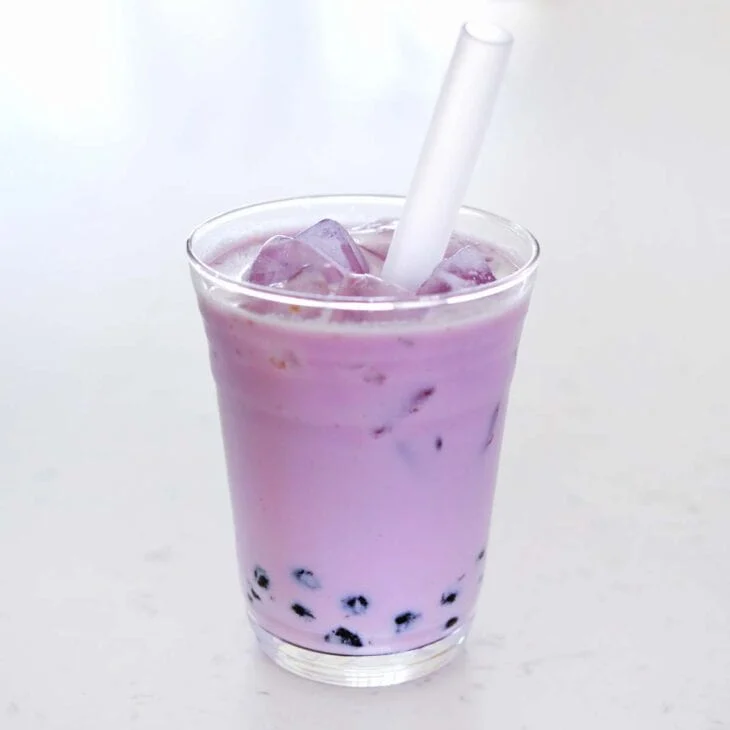
Taro Milk Tea

A single taro milk tea at most bubble tea shops runs $6–8. Make it at home and the cost drops to about $1.50 per serving once your supplies are stocked. The problem: most first-timers buy the wrong ingredients, end up with something that tastes like purple chalk, and give up before they understand what went wrong.
What Taro Milk Tea Is (and Why That Purple Color Is Often Fake)
Taro milk tea is a cold shaken drink made from taro root, milk or creamer, a sweetener, and tea — usually black, though many recipes skip tea entirely for a caffeine-free taro milk. It originated in Taiwan as part of the bubble tea wave and spread globally through chains like Gong Cha, Tiger Sugar, and Kung Fu Tea.
Most guides treat taro like a single, simple ingredient. It isn’t.
Real Taro vs. Taro Flavoring: What’s Actually in Your Cup
Real taro (Colocasia esculenta) is a starchy root vegetable. Raw, it tastes mildly sweet and nutty — something between vanilla, sweet potato, and a plain baked potato. When cooked and blended into a drink, it turns pale beige or very light purple. Not the vivid violet you see on Instagram.
That bright purple? Almost always artificial coloring — or ube (purple yam), a completely different root. Ube is sweeter, has a coconut-vanilla note, and turns vivid purple-pink. Many shops and home recipes use ube powder and call it taro because the color photographs better. Neither is wrong. But you need to know which one you’re buying before you spend money on anything.
Why the Color Varies So Much Between Shops
Taro contains small amounts of anthocyanins — the same pigment in blueberries and red cabbage. The concentration varies by variety and how the root was processed. Some commercial powders produce beige. Some turn light lavender. Shops like Presotea and Sharetea use pre-mixed powders that include colorant, which is how they maintain consistent purple at scale.
For home use: if you want reliable color without artificial dyes, add ¼ teaspoon of butterfly pea flower powder to your taro base per serving. Flavor impact is minimal. Color improvement is noticeable.
The Exact Flavor Profile You’re Trying to Recreate
Good taro milk tea is mildly sweet — less so than a fruit bubble tea. It’s creamy from non-dairy creamer or whole milk, never watery. There’s a faint earthy, vanilla-like background note that comes specifically from the taro root. And there’s a slight starchy thickness in texture that separates it from fruit teas and smoothies entirely.
If your homemade version tastes artificial or one-dimensional, the problem is almost always too much powder or the wrong type of powder. The ratio matters more than any other single variable in this drink.
Taro Ingredient Options: A Comparison
There are four realistic ways to add taro flavor at home. Here’s how they compare across what actually matters:
| Ingredient | Flavor Accuracy | Natural Color | Prep Time | Cost Per Serving | Best For |
|---|---|---|---|---|---|
| Fresh Taro Root | Best — complex, earthy | Pale beige or light purple | 45–60 min | ~$0.80 | Batch prep, serious home cooks |
| Commercial Powder (Bossen / Fanale) | Very Good — matches shop flavor | Purple (colorant included) | 2 min | ~$0.40 | Most home users |
| Consumer Powder (Anthony’s Goods) | Good — pure, mild, earthy | Off-white to beige | 2 min | ~$0.60 | Clean-label preference |
| Taro Paste or Concentrate | Strong and sweet — dessert-like | Purple (usually) | 1 min | ~$0.50 | Fast drinks, pre-sweetened |
Which Powder Tastes Closest to a Shop
Bossen Taro Powder (~$18 for 2.2 lb on Amazon and through Asian grocery distributors) is what most small bubble tea shops actually stock. It contains non-dairy creamer, taro flavoring, and colorant already blended — dissolve it in warm water, add ice, shake, and serve. The flavor is intentionally sweet and processed, which is exactly what recreates that shop experience. Fanale Taro Powder is the other dominant option at a similar price point, slightly more vanilla-forward. Either works, and both are far superior to anything sold in a small consumer sachet at a grocery store.
For a cleaner ingredient list: Anthony’s Goods Organic Taro Root Powder (~$15 for 1 lb on Amazon) is pure dried taro with no additives. The flavor is subtler and earthier. You’ll need to add your own sweetener and either accept a beige color or supplement with a natural colorant like butterfly pea flower or beet powder.
The Milk Decision
Whole milk works fine. But shop-style taro milk tea typically uses non-dairy creamer powder because it creates a thicker, more stable emulsion that doesn’t separate as quickly in ice. Replacing half the milk with a tablespoon of Coffee-Mate Original powder dissolved in warm water makes a noticeable difference in texture — richer, creamier, and closer to what you pay $7 for at a shop.
Oatly Barista Edition is also a strong choice — slightly thinner than the creamer approach, but a better option for people who find non-dairy creamers too artificially rich. Skim milk and most generic oat milks produce a thin, watery result. Skip both.
How to Make Taro Milk Tea at Home: Step-by-Step
This makes one 16 oz serving using Bossen Taro Powder — the most direct route to shop-quality results at home:
- Brew black tea — 1 bag of Lipton Yellow Label or any Assam blend in 4 oz of boiling water for 5 minutes. Let cool to room temperature. Skip this entirely for a caffeine-free version.
- Dissolve taro powder — 3 tablespoons (20g by weight) of Bossen Taro Powder in 4 oz warm water. Stir until fully smooth with no lumps visible.
- Check sweetness — Bossen is pre-sweetened. If using Anthony’s pure taro powder, add 1–2 tablespoons of simple syrup or honey now.
- Add milk — Pour in 6 oz of whole milk or Oatly Barista. Stir briefly to combine.
- Shake — Fill a cocktail shaker with ice, add all liquid, shake hard for 30 full seconds until the exterior is cold and frosty.
- Pour over fresh ice — Into a 24+ oz glass or Ball Wide Mouth Mason Jar (32 oz, ~$12 for a 4-pack). Wide-mouth jars are the easiest home option and look good on a countertop.
- Add boba pearls — Go in last. See below for which pearls to buy and how to cook them correctly.
The Tapioca Pearl Problem Nobody Warns You About
Pre-cooked boba from vacuum pouches goes rubbery within 2 hours of opening. Fine for immediate use, but the texture suffers compared to fresh-cooked. Cook dry pearls instead.
WuFuYuan Black Tapioca Pearls (green package, ~$3 at most Asian grocery stores, ~$8 on Amazon): bring at least 8 cups of water to a full rolling boil per cup of dry pearls. Add pearls. Boil 20 minutes. Turn off heat, lid on, rest 20 more minutes. Drain. Immediately toss with a tablespoon of brown sugar syrup or honey to prevent sticking and add the signature caramel undertone. Don’t rush the resting step — pulling pearls early leaves hard centers that ruin the texture of every sip.
Why Shaking Matters More Than You Think
Stirring doesn’t fully combine taro powder with cold milk. A sediment layer settles halfway through the drink — you taste chalky starch right when you’re nearing the bottom. Shaking with a cocktail shaker (the OXO Steel Cocktail Shaker at ~$20 is durable and easy to clean) solves this completely. Shake until the exterior feels cold. That’s 25–30 seconds of actual effort, not a quick back-and-forth.
Mistakes That Ruin Most Homemade Taro Milk Tea
Most bad homemade taro milk tea fails because of the powder, not the technique. Three mistakes account for almost every disappointing result:
Buying Ube Powder When You Wanted Taro
Ube (purple yam, Dioscorea alata) and taro are different plants with meaningfully different flavor profiles. Suncore Foods Purple Yam (Ube) Powder (~$12 on Amazon) is widely sold and easy to mistake for taro — the packaging is often similar and the powder is purple. But it produces a sweeter, coconut-vanilla drink, not the mild earthy flavor of classic taro milk tea. Check the label before buying. If it says ube, purple yam, or Dioscorea anywhere, it’s not taro. Return it and buy Bossen or Anthony’s instead.
Using Too Much Powder — and Mixing It Cold
Two related mistakes that usually happen together. Three tablespoons (20g) of commercial taro powder per 16 oz serving is the correct baseline. Most beginners use 4–5 tablespoons, thinking more flavor equals a better drink. The result is dense, chalky, and cloying — exactly the taste that makes people say they don’t like taro. Start at 2.5 tablespoons and work up in half-tablespoon increments until you find your preference.
Always dissolve taro powder in warm water first. Not boiling — warm. Cold water creates lumps that settle and never fully incorporate, no matter how long you shake. This step gets skipped in most tutorials, and it causes more texture failures than any other single error in the process.
Measuring by Volume Instead of Weight
A heaping tablespoon of taro powder can be 35–40% more powder than a level one, depending on how the bag was stored and how loosely it’s packed. Measuring by weight removes this variable completely. Use 20g of Bossen Taro Powder per 16 oz serving, every time, and the result is consistent. The Ozeri Pronto Digital Kitchen Scale (~$13 on Amazon) is the cheapest reliable option and handles this perfectly. The OXO Good Grips 11 lb Food Scale (~$50) is better built and earns its place in a home kitchen beyond just bubble tea.
Homemade vs. Shop: The Honest Verdict
If you drink taro milk tea twice a week or more, make it at home. The $65–80 initial setup — powder, pearls, shaker, mason jars, straws, and a kitchen scale — pays back within the first month against shop prices of $6–8 per cup. The math is not close.
Once a month? Don’t bother. Just buy it.
Tools to Buy and Tools to Skip
Do I need a blender?
No — not for powder-based taro milk tea. A cocktail shaker handles this completely. You only need a blender if you’re working from fresh cooked taro root, which requires full pureeing before it’ll mix smoothly into a drink. If you go that route, the Ninja BN701 Professional Plus Blender (~$100) is enough for home use. The Vitamix A2500 (~$450) produces a smoother result but is overkill for a home bubble tea setup — save it for smoothies and soups where the quality gap is actually noticeable.
What straws do I actually need?
Standard drinking straws can’t pass tapioca pearls — you need at least 12mm diameter. Alink 12mm Disposable Bubble Tea Straws (~$8 for 100 on Amazon) are the easiest solution for getting started. For a reusable option, Hiware Reusable Stainless Steel Boba Straws (~$10 for a 4-pack with a cleaning brush) are dishwasher-safe and last indefinitely. The extra $2 for reusable is worth it within the first three drinks.
Is a cup sealer necessary?
No. Commercial cup sealers for that peel-off film top cost $150–800 and are designed for shop volume — dozens of cups per hour. For home use, a Ball Wide Mouth Mason Jar with or without a lid works perfectly. Skip the sealer entirely. It solves a problem you don’t have at home.
The full home setup worth buying: Bossen Taro Powder ($18), WuFuYuan Tapioca Pearls ($8), OXO Steel Cocktail Shaker ($20), Ball Wide Mouth Mason Jars ($12 for 4), Hiware Boba Straws ($10), Ozeri Kitchen Scale ($13). That’s roughly $81 total for a setup that covers 45+ servings before you need to restock powder alone.
Knowing your taro powder from your ube powder is the single most important thing you can learn before spending a dollar on anything else.