Hushpuppies

Most people treat hush puppies like deep-fried cornbread balls. That’s the mistake. Cornbread and hush puppy batter look nearly identical in the bowl, but the ratios and technique are different enough that following a cornbread recipe and dropping it into hot oil gives you dense, greasy rounds — not the crispy-outside, tender-inside result worth repeating.
The difference comes down to four things: the cornmeal grind, how long you stir the batter, the rest time before frying, and the oil temperature. Get those right and hush puppies become one of the fastest, most satisfying things you can fry at home. This tutorial covers all four — plus the equipment, the common failures, and the one variation most worth making.
What Actually Makes Hush Puppies Different from Cornbread
The texture of a good hush puppy depends on a specific reaction: the batter seals the moment it contacts hot oil, trapping steam inside. That steam cooks the interior while the sealed shell crisps. Cornbread doesn’t work this way. It bakes, which means moisture escapes gradually through the entire surface. Hush puppies trap it — that’s why the contrast between crust and center is so much sharper.
This is a Southern dish rooted in fish fry culture. The origin was practical — cooks needed something to fry fast alongside catfish or bass. The name comes from the often-repeated story of tossing fried cornmeal to quiet the dogs. Food historians debate whether that’s accurate. Either way, the dish has been consistent across the South for well over a century.
What actually drives the texture at the ingredient level:
- Cornmeal grind is the biggest variable. Stone-ground medium grind gives the interior structure and a slightly irregular crumb. Fine grind produces a pasty, homogeneous texture that reads more like a fritter. Bob’s Red Mill Stone Ground Medium Grind Yellow Cornmeal ($5 for 24 oz) is the accessible standard. Anson Mills Stone-Ground Yellow Cornmeal ($7 for 12 oz) is the premium version — more pronounced corn flavor, slightly coarser texture, noticeably better if you’re cooking for guests.
- One large egg per cup of dry ingredients. More than that and the interior gets gummy. Less and it falls apart when you bite in.
- Buttermilk adds acidity that reacts with baking powder, producing more gas bubbles and a lighter crumb than regular milk provides.
- Grated yellow onion, always. It adds moisture, a subtle savory baseline, and keeps the interior from drying out during the fry. Omit it and the cornmeal flavor goes flat.
The sugar debate is real. North Carolina style often includes a tablespoon or two. Mississippi style skips it entirely. For a dinner table context — served alongside soup, stew, or BBQ — the lightly sweet version works better as a standalone bite and pairs naturally with honey butter.
The Cornmeal-to-Flour Ratio That Gets the Texture Right
Standard ratio: 1 cup stone-ground cornmeal to 1/2 cup all-purpose flour. Drop below that flour amount and they fall apart in the oil before they cook through. Go above 3/4 cup flour and you’ve made corn muffin bites — a different food wearing the wrong name.
Baking powder is undersold in most recipes. Use 1.5 teaspoons per batch. That level of leavening creates enough gas expansion in hot oil that the interior cooks through before the exterior gets too dark. Under-leaven and you consistently pull out pieces with doughy centers — technically cooked, structurally wrong.
Why Buttermilk Changes the Result
Regular milk produces a slightly tighter crumb and a crust that softens faster after frying. The acid in buttermilk reacts with baking powder more aggressively — more bubbles, more lift, a more open interior texture. The difference is noticeable side-by-side.
No buttermilk available: add 1 tablespoon white vinegar to 1 cup whole milk, stir, and wait 5 minutes. It’s not identical, but it’s a workable substitute for weeknight cooking. Low-fat milk gives thinner batter and a less crispy result — whole milk or buttermilk is the better call either way.
Equipment That Makes or Breaks the Fry
| Equipment | Best Option | Price | Why It Matters |
|---|---|---|---|
| Cast Iron Skillet | Lodge L8SK3 (12-inch) | $35 | Retains heat under cold batter; recovers temperature fast between batches |
| Electric Deep Fryer | Presto FryDaddy | $28 | Built-in thermostat removes the temperature guesswork entirely |
| Instant-Read Thermometer | ThermoPro TP19 | $20 | 2-second read, ±0.9°F accuracy — makes precise temperature control achievable |
| Spider / Slotted Tool | OXO Good Grips 5.5-inch Spider | $15 | Wide basket lifts multiple pieces at once without fumbling with tongs |
| Draining Setup | Wire rack over rimmed baking sheet | $12 | Paper towels alone trap steam underneath and soften the crust immediately |
The Lodge L8SK3 12-inch cast iron skillet is the right home setup for this. You need at least 3 inches of oil depth, and the Lodge achieves that with 4 to 5 cups. Cast iron holds heat under load. When you drop cold batter into a thin stainless pan, the oil temperature drops 25–35°F almost immediately. Cast iron drops maybe 10°F and recovers in under a minute — that difference is the entire gap between a crispy crust and an oil-soaked one.
The Presto FryDaddy ($28) works well if you fry more than once a month. The built-in thermostat removes the biggest variable in the process. It holds 4 cups of oil, enough for 4–5 rounds without crowding. Cleanup is straightforward: drain, wipe, done.
One thing most home cooks overlook: the draining setup. Paper towels trap steam against the bottom of the hush puppy, softening the crust almost immediately. A wire rack over a rimmed baking sheet lets air circulate underneath. The difference in crust texture after 5 minutes is noticeable — it stays crisp several minutes longer when air can move around the entire piece.
The One Tool Most Cooks Skip
A thermometer. The ThermoPro TP19 reads in 2 seconds and is accurate to ±0.9°F. At $20, it’s the cheapest upgrade with the highest payoff. Without it, you’re guessing — and most people guess low, which is exactly how you end up with oil-soaked interiors. Fry too hot and the outside burns before the inside cooks through. The thermometer is the complete solution to both problems. There is no good workaround.
Step-by-Step: The Base Recipe (Serves 4–6)
Ingredients: 1 cup Bob’s Red Mill stone-ground medium cornmeal · 1/2 cup all-purpose flour · 1.5 tsp baking powder · 1/2 tsp salt · 1/4 tsp black pepper · 1 large egg · 3/4 cup buttermilk · 1/2 small yellow onion (grated) · 4–5 cups peanut oil or canola oil for frying.
- Heat oil in the Lodge 12-inch skillet to 360°F. Check with the ThermoPro TP19 before adding anything. Do not estimate by sight or sound.
- Whisk cornmeal, flour, baking powder, salt, and pepper together in a large mixing bowl.
- In a second bowl, beat the egg, then add buttermilk and grated onion. Mix to combine.
- Pour wet ingredients into dry. Stir with 10–12 strokes. Stop when you no longer see dry pockets of flour. Lumps are fine — overmixing is the enemy.
- Rest the batter 5 minutes. Baking powder needs time to activate before the batter hits hot oil.
- Use a 1.5-tablespoon cookie scoop to portion batter into the oil. Uniform size means uniform cooking time across the batch.
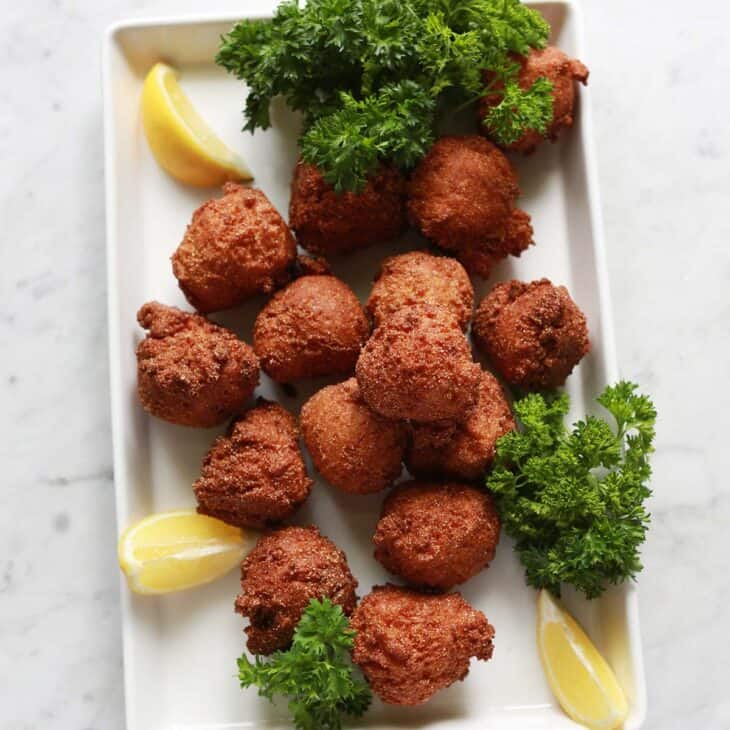
- Fry 4–5 pieces per batch. Turn once at 90 seconds. Total fry time: 2.5 to 3 minutes. Pull them when they’re deep golden brown, not pale yellow.
- Remove with the OXO spider. Drain on a wire rack set over a rimmed baking sheet — not directly on paper towels.
- Serve immediately. The crunch softens noticeably within 15 minutes, so time your batches to your meal.
Why Batch Size Controls Texture
Drop more than 5 pieces into a 12-inch skillet and the oil temperature falls below 330°F. Below that point, the batter doesn’t seal fast enough. Oil soaks in. You get heavier, greasier hush puppies with a soft exterior instead of a crisp one. Four or five per batch maintains frying temperature. It feels slower than it is — each batch takes only 3 minutes.
What to Serve Alongside
The classic pairing is fried catfish or pulled pork. At a weeknight dinner table, hush puppies work as a bread replacement with chili, fish stew, or slow-cooked BBQ. Honey butter — 1 part honey to 2 parts softened unsalted butter — makes them dinner-party quality. Mix the night before and refrigerate; it keeps for a week and takes 2 minutes to make.
Oil Temperature Is Everything
360°F. Not “medium-high heat” — a setting that varies between every stove and every pan. Not “when a drop of batter sizzles.” 360°F, measured with a thermometer.
Below 340°F, the batter doesn’t seal before oil soaks in. Above 380°F, the exterior burns before the interior cooks through. A $20 thermometer solves both problems completely. There is no substitute for this single number.
Four Mistakes That Consistently Ruin Hush Puppies
- Overmixing the batter. Stop at 10–12 strokes. Gluten develops fast in wet cornmeal batter. Overmixed hush puppies have a tight, rubbery crumb — you’ll notice it as a uniform, dense texture instead of an open, slightly irregular interior. If yours consistently come out dense regardless of oil temperature, overmixing is almost certainly the cause.
- Skipping the batter rest. The 5-minute rest isn’t a suggestion. Baking powder starts reacting when it contacts liquid, and it needs time to produce enough gas before the batter hits oil. Skip the rest and you get noticeably flatter, denser results with less contrast between crust and center.
- Using fine-grind cornmeal. Fine-grind cornmeal becomes paste inside the hush puppy. The interior needs structure — use Bob’s Red Mill Medium Grind or Anson Mills Stone-Ground Yellow Cornmeal. If the only cornmeal you have is fine-grind, don’t try to compensate with extra flour. Adding more flour pushes you into corn muffin territory. It’s worth buying the right grind before you start.
- Frying in the wrong oil. Butter burns at 300°F — well below target. Olive oil smokes before it hits 360°F and adds an off flavor to every batch. Peanut oil is the traditional choice: neutral flavor, 450°F smoke point. Canola or vegetable oil at $4–6 per bottle works fine. Avoid anything with a smoke point under 400°F.
Three Variations Worth Making
Can I add jalapeño?
Yes — and this is the best hush puppy variation by a significant margin. Finely dice one jalapeño (seeds removed for mild, seeds included for real punch) and fold into the finished batter right before frying. This is the standard at Southern fish camps for good reason. The fresh, sharp heat cuts through the fried richness in a way that nothing else does. Use two jalapeños if you want the heat to be genuinely noticeable rather than just a background note.
What about cheddar hush puppies?
Add 1/3 cup shredded sharp cheddar to the dry ingredients before mixing. Tillamook Sharp Cheddar works well because it has enough fat content to melt evenly without making the batter greasy. Avoid pre-shredded cheddar — the anti-caking agents affect how it melts inside the batter. Shred it fresh. Aged or extra-sharp varieties can make the interior slightly gummy; sharp or medium-sharp is the right call.
Can I make hush puppy batter ahead of time?
Mix dry ingredients up to 3 days in advance and store sealed at room temperature. Mix wet ingredients up to an hour before frying. Never mix the complete batter ahead — once baking powder contacts liquid it starts reacting, and it loses meaningful lifting power within 20–30 minutes. Fully fried hush puppies hold well on a wire rack in a 200°F oven for up to 30 minutes before they lose their crunch.
When to Skip the Deep Fry
Air fryer hush puppies exist. Make them for health or convenience reasons, not because you think the result will be better.
The frying step is structural, not incidental. Hot oil contact seals the batter surface in seconds, trapping moisture inside and building the crust-to-interior contrast that defines the dish. An air fryer circulates dry heat — it dries the exterior rather than sealing it. The result is a skin-like surface instead of a crispy shell, with a drier, more uniform interior throughout. It’s a different food wearing the same name.
If you want the closest air fryer approximation, the Philips Premium Air Fryer XXL ($300) gets there better than most. Spray batter portions heavily with avocado oil spray, cook at 390°F for 8–10 minutes, flip at the halfway point. They’re acceptable. But if you’ve eaten a properly fried hush puppy, you’ll taste the gap immediately.
The better lower-oil option: shallow frying. Pour 1/2 inch of peanut oil into the Lodge 12-inch skillet, heat to 360°F, and fry as normal. You won’t get a full 360-degree crust, but you’ll get crisp sides and a solid base with real crunch. It uses about 40% less oil than full submersion and delivers close enough to the real result to be worth making on a weeknight without a full fry setup.
Baked hush puppies are a different food entirely. Corn muffin bites, essentially. Fine for a different purpose, wrong category.
Master the fundamentals — the right cornmeal grind, the rested batter, the measured oil temperature, the small batch size — and you’ll understand exactly why hush puppies are their own category. Not cornbread’s rougher cousin. A distinct dish with a specific technique that produces a texture cornbread simply can’t replicate.