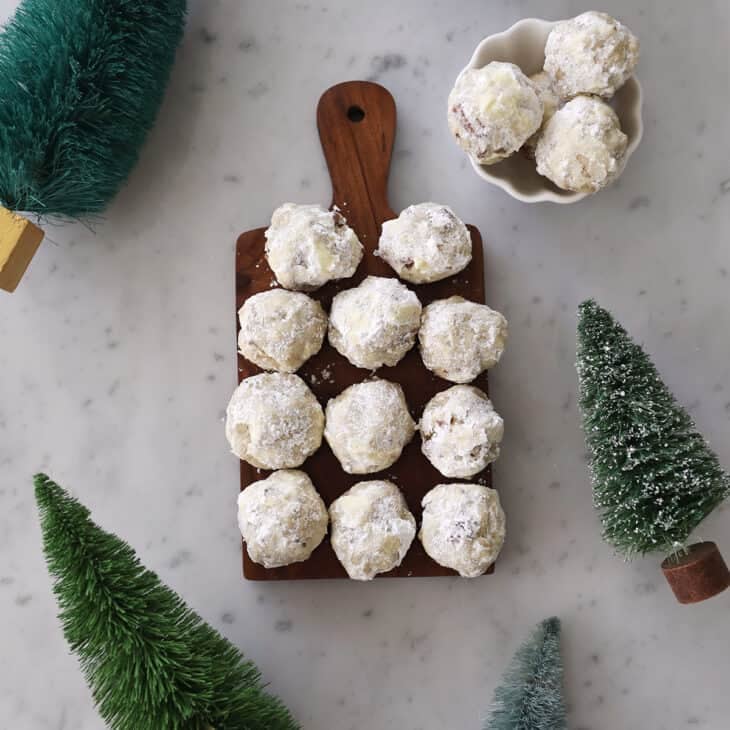
Snowball Cookies

You pull a tray from the oven, wait two minutes, roll one cookie in powdered sugar — and it cracks in half. The coating turns translucent before guests arrive. This happens to careful bakers consistently, and the cause is almost always one of four fixable errors.
The Four Root Causes Behind Crumbling Snowball Cookies
Before changing the recipe, identify which failure mode you are actually dealing with. The corrections are different for each cause, and applying the wrong fix makes things worse.
- Over-measured flour: Scooping flour directly from the bag compacts it. A cup that should weigh 120g — King Arthur Flour’s published standard — easily reaches 150 to 160g when scooped. That extra 25 to 30 percent dries the dough and prevents it from holding together. Use a kitchen scale. If measuring by volume, spoon flour into the cup and level with a straight edge. Never scoop directly from the bag.
- Butter at the wrong temperature: Snowball cookie dough needs butter at roughly 65°F — soft enough to cream, firm enough to hold structure. Land O’Lakes unsalted butter that leaves a deep fingerprint when pressed is too warm; the dough will spread flat and crack after baking. Too cold and the fat won’t distribute evenly through the flour, producing a crumbly result regardless of how carefully you roll. An instant-read thermometer removes the guesswork entirely.
- First powdered sugar coat applied too late: The first coat needs to go on while cookies are still warm — 2 to 3 minutes out of the oven. Residual heat helps the sugar adhere to the surface. Wait until fully cool and it won’t bond. Apply while still too hot and the sugar melts to paste. The window is narrow, and most recipes significantly understate how much the timing matters.
- Untoasted or coarsely chopped nuts: Raw nuts carry more moisture than toasted ones, and large pieces create structural breaks in the dough where the flour-fat matrix is interrupted at irregular intervals. A 5-minute toast at 350°F before grinding drives off excess moisture and firms the nut structure. This single step produces a more consistent result than almost any other adjustment in the recipe.
A note for bakers above 3,500 feet: high-altitude conditions change how butter and flour behave slightly. Reduce flour by 1 to 2 tablespoons per cup and compensate with a small additional amount of butter. Results vary — the guidance above is calibrated for standard elevation.
What Actually Holds a Snowball Cookie Together
Snowball cookies belong to the shortbread family. They hold together through fat and flour alone — no eggs, no liquid binders. Everything depends on the butter-to-flour ratio and how fat coats flour particles during mixing. Understanding this structure is what separates a baker who troubleshoots effectively from one who just keeps switching recipes.
At the correct ratio, fat forms a continuous matrix around flour particles. When baked, that matrix sets into a stable, crumbly-but-coherent structure. When the ratio is off in either direction — excess flour or excess butter — the matrix either fractures under handling or spreads too thin to maintain shape.
The Butter-to-Flour Ratio That Holds
The reliable range is a 1:2 butter-to-flour ratio by weight: 227g of butter to approximately 480g of all-purpose flour for a standard batch. This is not a rough starting point — it is the structural threshold for a cookie that holds together during rolling, handling, and storage.
The Joy of Cooking (2019 edition, page 769) uses exactly this ratio. So does the Nestlé Toll House Pecan Snowball recipe. Both are high-volume tested formulas with decades of home kitchen validation behind them. If your recipe specifies 3 cups of flour to 1 cup of butter and your cookies are crumbling, weigh the ingredients before assuming your technique is at fault — volume measurements drift significantly depending on how flour was stored and scooped.
European versions, particularly Greek kourabiedes, push toward a 1:1.8 ratio (slightly more butter). The texture becomes more melt-in-mouth and delicate, but the cookies are noticeably more fragile — they need same-day serving and don’t survive being packed into a tin. For holiday cookies that need to last 5 to 7 days or be gifted, the standard 1:2 ratio is the more practical choice in almost every situation.
Why Nut Grind Size Changes the Structure
Nuts in snowball cookies should be ground to a fine meal — closer to the texture of Bob’s Red Mill Super-Fine Almond Flour than to chopped nuts. Fine particles distribute uniformly through the dough rather than creating structural weak points where large pieces interrupt the fat-flour matrix. A food processor with 10 to 15 short pulses achieves the right texture without crossing into nut butter territory.
Over-processing is a real failure mode here. When pecans are ground too fine, the released oil makes the dough greasy and prone to spreading flat during baking. The target texture is like coarse sand: individual particles visible, nothing clumping together.
Where Vanilla Quality Actually Shows
In a cookie with this few competing flavors, vanilla competes only with butter and powdered sugar. Nielsen-Massey Pure Vanilla Extract — about $15 for 2oz — performs noticeably better than imitation vanilla because there is nothing else to hide quality differences behind. Standard amount: 1 teaspoon. A variation worth trying: reduce to ½ teaspoon vanilla and add ¼ teaspoon almond extract. The almond note adds complexity without being recognizable as a distinct almond flavor.
Snowball Cookies vs. Similar Recipes: What the Differences Actually Are
These cookies go by at least five names, and many recipes treat them as distinct products when the technical differences are mostly minor. Here is what the comparison actually shows:
| Cookie Name | Nut Type | Butter:Flour Ratio | Texture | Best Use Case |
|---|---|---|---|---|
| Snowball Cookies | Pecans or walnuts | 1:2 | Soft, melts in mouth | Holiday platters, gifting, 5-7 day shelf life |
| Russian Tea Cakes | Walnuts (traditional) | 1:2 | Identical to snowball cookies | Same cookie — regional name only |
| Mexican Wedding Cookies | Pecans | 1:2 to 1:1.8 | Slightly more crumbly | Celebrations, higher nut-to-flour ratio |
| Pecan Sandies | Pecans | 1:2.5 (less butter) | Crisp, sandy, firmer | Everyday snacking, longer shelf life |
| Greek Kourabiedes | Almonds | 1:1.8 (more butter) | Very delicate, rich | Same-day serving only, does not travel |
The honest verdict: Russian tea cakes and snowball cookies are the same cookie with different regional names. Mexican wedding cookies use the same base recipe but typically with a higher nut percentage and slightly more butter. Any recipe insisting these are fundamentally different products is making a marketing distinction, not a technical one. For first-time bakers, the standard American snowball cookie ratio is the most forgiving entry point and the most reliable for gifting.
Getting the Technique Right: The Questions That Actually Matter
What should the dough feel like before baking?
Correctly made dough holds its shape when pressed together but does not stick to your palms. You should be able to roll a 1-inch ball between your hands without it cracking or crumbling. If it crumbles while rolling, there is too much flour or the butter was too cold at mixing time. If it sticks to your hands, the butter was too warm when you started.
A KitchenAid stand mixer on speed 2 creams properly tempered butter and powdered sugar in about 3 minutes. A hand mixer at medium speed needs 4 to 5 minutes. The goal is a pale, fluffy mixture before adding flour — incomplete creaming creates uneven fat distribution and inconsistent texture across the batch.
What temperature and how long in the oven?
350°F (175°C), 11 to 13 minutes, center rack. The cookies should look barely set — pale on top, just slightly golden on the bottom edge. They feel soft when they come out. That is correct; they firm as they cool. Overbaking by even 2 minutes produces a brittle cookie that cracks on handling. If baking two trays simultaneously, rotate front-to-back at the 6-minute mark to compensate for hot spots.
How do you apply the powdered sugar without it turning translucent?
Two coats, timed precisely:
- Warm coat: 2 to 3 minutes after pulling from the oven, roll each cookie gently in a bowl of sifted Domino Powdered Sugar. Warmth helps sugar adhere without melting completely into the surface.
- Cool coat: After 30 minutes at room temperature, roll each cookie again. This second coat provides the bright white, snowy appearance the cookies are known for. Skip it and they look thin and slightly yellow-tinged.
Sift the powdered sugar before rolling. Unsifted sugar carries clumps that create uneven, patchy spots on the finished cookies.
Toast the Pecans First — This Matters More Than Switching Recipes
Five minutes at 350°F on a dry sheet pan. Cool completely before grinding. Toasted versus raw pecans produce a more structurally sound, richer-tasting cookie than upgrading butter, changing flour brands, or using premium vanilla. If your current batches are inconsistent, address this before adjusting anything else in the recipe.
Variations Worth Making — and One That Isn’t
The base recipe needs no modification to succeed. Of the variations circulating online, three genuinely improve on the original for specific situations. One makes the cookie structurally worse in two measurable ways.
Chocolate-Dipped Snowball Cookies
After completing both powdered sugar coats, dip the bottom half of each cookie into melted Ghirardelli 60% Cacao Bittersweet Chocolate Chips — about 1 cup of chips melted for a standard 36-cookie batch. Set on parchment at room temperature for 45 to 60 minutes until the chocolate is fully set. The bitterness of dark chocolate against the sweet powdered sugar coating is a genuinely strong flavor combination. One critical step: both sugar coats must be applied before dipping. The chocolate needs a textured surface to grip; bare cookie will not hold it properly.
Gluten-Free Version with Almond Flour
Substitute Bob’s Red Mill Super-Fine Almond Flour 1:1 by weight for all-purpose flour and reduce oven temperature to 325°F — almond flour browns faster than wheat flour at standard temperatures. The resulting texture is slightly denser but holds together well because of almond flour’s natural oil content. For guests avoiding gluten, this version produces a legitimate, good-quality cookie rather than the usual compromise that requires explanation at the table.
The Lemon Zest Version — Skip It
Adding lemon zest introduces moisture that disrupts the butter-flour balance and makes dough harder to roll without cracking. Most of the citrus flavor burns off during baking. What survives is buried under two coats of powdered sugar. The cookies do not taste noticeably lemony, and the texture is worse for the addition. If citrus flavor is the goal, a rolled lemon shortbread format gives the flavor room to come through. This structure does not.
Storage and Gifting
In an airtight container at room temperature: 7 to 10 days with no quality loss. Frozen: up to 3 months. Freeze in a single layer first, then transfer to a freezer bag once solid. Thaw at room temperature for 30 minutes before serving. Frozen cookies always shed their sugar coating during thaw, so plan for a re-roll in fresh sifted sugar before putting them on the table.
For holiday gifting, pack in a tin lined with parchment and include a small bag of extra Domino Powdered Sugar — cookies lose their coating in transit, and a quick re-dust before serving makes a meaningful difference in how they look at their destination. For bakers troubleshooting a crumbling batch: a kitchen scale for flour measurement and toasted pecans address the majority of failure cases without changing anything else about the recipe.