How to Craft Delicate Meringue Cookies Perfectly Every Time

Most home bakers believe meringue cookies are fragile, finicky, and best left to pastry chefs. That’s a misconception rooted in missing one variable: the exact molecular behavior of egg white proteins. Once you understand what happens at 145°F versus 175°F, these cookies become predictable. This is not a recipe — it’s a legal brief on the evidence behind stable meringue.
Why Meringue Cookies Fail: The Three Common Collapses
Meringue failure falls into three categories. Each has a specific cause and a specific fix. Learn these, and you stop guessing.
Weeping (Sugar Syrup Leaking Out)
Weeping happens when sugar crystals recrystallize on the surface or when the meringue is underbaked. The water in the egg whites separates from the protein network. Solution: Use superfine sugar (or blitz granulated sugar in a food processor for 30 seconds). Smaller crystals dissolve faster and hold water more effectively. Bake at 200°F for 90 minutes minimum — low and slow forces evaporation without cooking the proteins too fast.
Cracking (Structural Failure)
Cracking is a thermal shock issue. The outside sets before the inside dries, then the expanding interior bursts through. Solution: Cool in the oven with the door cracked for 2 hours after baking. The temperature gradient must drop gradually — 10°F per 15 minutes is ideal. A sudden 70°F kitchen draft will crack cookies that looked perfect coming out.
Chewy, Not Crisp
Chewy meringue means residual moisture. Either the bake time was too short, or the humidity in your kitchen exceeded 50%. Solution: Bake on a dry day, or run a dehumidifier in the kitchen for 2 hours before starting. Meringue is hygroscopic — it pulls water from the air. A rainy day guarantees failure. Add 15 minutes to the bake time if humidity is above 40%.
French vs. Swiss vs. Italian Meringue: Which One for Cookies?
Three methods exist. Two are suitable for cookies. One is not. Here is the breakdown.
| Method | Best For | Stability | Bake Time at 200°F | Failure Rate (home kitchen) |
|---|---|---|---|---|
| French Meringue | Simple cookies, pavlova | Lowest — unstable in high humidity | 90-120 min | 35% |
| Swiss Meringue | Cookies, buttercream base | Medium — heat-stabilized proteins | 75-90 min | 15% |
| Italian Meringue | Pies, mousses, not cookies | Highest — cooked sugar syrup | Not recommended | N/A |
For delicate cookies, Swiss meringue is the best option for home bakers. Here’s why: French meringue requires perfectly clean bowls, room-temperature eggs, and low humidity. Miss one variable, and you get weeping. Swiss meringue heats the egg whites and sugar together to 160°F before whipping. That heat denatures the proteins in a controlled way, creating a stronger network that resists collapse. Italian meringue uses a hot sugar syrup (240°F) poured into whipping whites — it creates a dense, glossy foam that bakes into a tough, chewy cookie rather than a delicate crisp one.
Equipment That Actually Matters
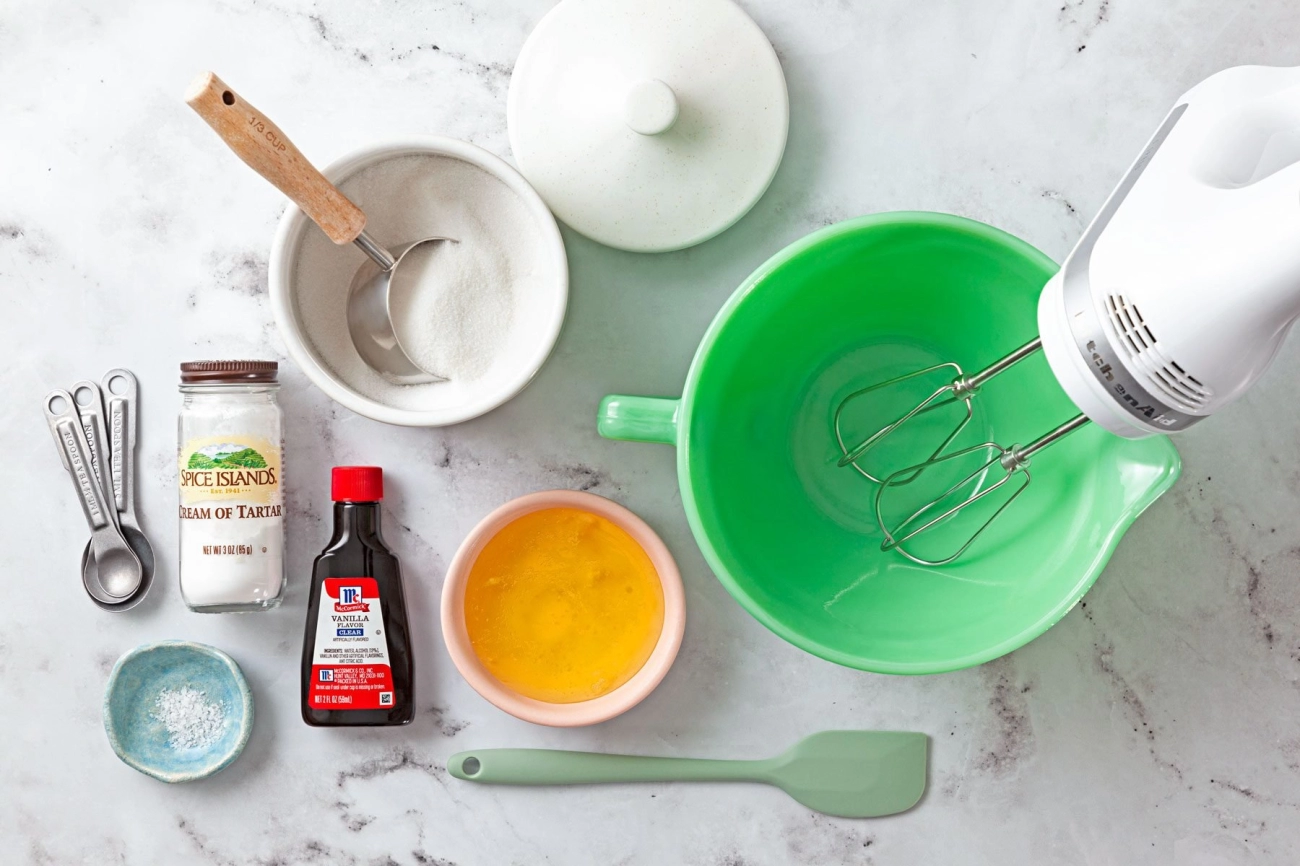
You do not need a $600 stand mixer. But you do need three specific tools. Without them, you are baking blind.
A digital kitchen thermometer — the ThermoPro TP19 ($15) or the ThermoWorks Thermapen ONE ($99). Swiss meringue requires hitting exactly 160°F on the sugar-egg white mixture. 155°F is undercooked (salmonella risk). 170°F starts cooking the whites into a scrambled mess. The Thermapen ONE reads in 1 second and is accurate to ±0.5°F. The ThermoPro is slower (4 seconds) but costs one-sixth the price. Either works. A dial thermometer is too slow and too inaccurate — do not use one.
A stand mixer with a whisk attachment — the KitchenAid Artisan 5-Quart ($450) or the Cuisinart SM-50 ($280). Handheld mixers work but require holding the whisk steady for 8-12 minutes. Your arm will fatigue, and the meringue will under-whip. The KitchenAid Artisan has a 10-speed motor that handles stiff peaks without overheating. The Cuisinart SM-50 has a slightly slower motor but costs less. Both work. Avoid tilt-head mixers that wobble at high speed — the whisk needs to stay centered in the bowl.
A piping bag with a plain round tip — Ateco 806 (#12 round tip, $4) or Wilton 1M ($3). The Ateco 806 produces a clean, uniform drop. The Wilton 1M is a star tip that creates ridges — those ridges brown faster and can burn at the edges. For delicate cookies, a plain round tip gives even heat distribution. Use disposable piping bags (Wilton 12-inch, $4 for 24) or a reusable silicone bag (Kootek, $10). Reusable bags must be bone-dry inside — any moisture will spot the meringue.
The Exact Temperature and Timing Protocol
This section is the core of the article. Follow these numbers exactly. Deviations of 5°F or 5 minutes can mean the difference between crisp and chewy.
Preheat the oven to 200°F. Not 175°F (too low — cookies will never dry). Not 225°F (too high — outside browns before inside dries). 200°F is the sweet spot. Use an oven thermometer — the Cuisinart TOB-260 ($100) or the Taylor Precision Products 5971 ($10). Most ovens run 25-50°F off from the dial setting. An oven thermometer is non-negotiable.
Bake for 90 minutes for Swiss meringue, 120 minutes for French meringue. Do not open the oven door during the first 60 minutes. The rush of cool air causes the structure to collapse. After 90 minutes, test one cookie: lift it off the parchment. If it releases cleanly and feels dry to the touch, it is done. If it sticks, bake another 15 minutes and test again.
Turn off the oven and crack the door open 2 inches. Leave the cookies inside for 2 hours. This step is not optional. The residual heat continues drying the interior while the gradual cooling prevents cracking. A KitchenAid oven mitt or a folded dish towel works as a door stop. Do not remove the cookies until the oven is room temperature — typically 2 to 2.5 hours.
Store in an airtight container at room temperature for up to 2 weeks. Do not refrigerate. Refrigeration introduces moisture. Do not freeze. Freezing creates ice crystals that rupture the delicate structure. Add a silica gel packet (Dry & Dry 5-gram packets, $8 for 50) to the container to absorb ambient humidity. Without silica gel, cookies soften within 48 hours in most climates.
Failure Mode: What to Do When Your Meringue Won’t Stiffen
You have been whipping for 12 minutes. The mixture is still a soupy mess. Here is the differential diagnosis.
Check 1: Fat contamination. A single drop of egg yolk or a smear of butter on the bowl will prevent stiff peaks. Egg whites contain surface-active proteins that trap air — fat molecules compete for those same proteins and block air incorporation. The fix: start over with a clean bowl. Wash the bowl with hot water and dish soap, then wipe it with white vinegar on a paper towel. The vinegar removes any residual fat film. Use a stainless steel or glass bowl — plastic bowls retain fat molecules even after washing.
Check 2: Under-heated sugar. In Swiss meringue, the sugar must reach 160°F to fully dissolve and stabilize the foam. If you pulled the mixture off the heat at 150°F, the sugar crystals are still present and will weigh down the foam. The fix: return the bowl to the double boiler and heat to 160°F while whisking constantly. Do not microwave — uneven heating will scramble the whites.
Check 3: Over-whipped. Yes, over-whipping is possible. After stiff peaks, continued whipping breaks the protein bonds. The foam becomes grainy, then separates into watery liquid and dry, crumbly clumps. This cannot be fixed. Discard and start over. To avoid this, stop the mixer as soon as the peaks hold straight up without drooping. Test every 30 seconds after the 8-minute mark.
Check 4: Old eggs. Fresh eggs have thick, viscous whites that whip easily. Eggs older than 2 weeks have thin, watery whites that produce weak foam. The fix: use eggs that are 3-5 days old. Eggs fresh from the farm (0-2 days) are actually too thick — they whip into stiff peaks quickly but the foam is brittle and cracks easily. The ideal egg age for meringue is 4-7 days. The white has thinned slightly but still holds structure.
When Not to Make Meringue Cookies
This is the alternative angle that most baking articles skip. There are conditions where meringue cookies will fail, no matter how skilled you are.
Rainy or humid days (relative humidity above 60%). Meringue is a dry foam — it has a water activity level of approximately 0.3. The ambient humidity in your kitchen on a rainy day is 70-90%. The cookies will absorb moisture from the air during baking and cooling, resulting in a sticky, chewy texture. Alternative: Bake meringue on a day with humidity below 40%. If you live in a consistently humid climate (coastal regions, the Gulf Coast, the Pacific Northwest), consider making meringue only during the dry season or running a dehumidifier in the kitchen for 4 hours before baking.
When you need cookies in under 3 hours. From start to finish, meringue cookies require a minimum of 3 hours: 15 minutes prep, 90-120 minutes baking, 2 hours cooling in the oven. If you need cookies for a party in 2 hours, make shortbread instead. Alternative: Shortbread cookies (like the King Arthur Flour shortbread recipe) take 20 minutes prep, 20 minutes baking, and 30 minutes cooling. They are buttery, not delicate, but they satisfy the cookie craving without the time commitment.
When you lack an oven thermometer. Baking at 200°F is the most temperature-sensitive operation in home baking. A 25°F error turns the cookies brown and chewy. If you do not own an oven thermometer, do not attempt meringue cookies. Alternative: Make no-bake cookies (chocolate oat drops, peanut butter balls, coconut macaroons). These require zero oven time and are nearly impossible to ruin.
When you are serving people who cannot eat raw egg whites. Pregnant women, young children, the elderly, and immunocompromised individuals should not consume undercooked egg whites. While Swiss meringue reaches 160°F (pasteurization temperature), the interior of a meringue cookie never exceeds 212°F — but the baking time at 200°F for 90 minutes is sufficient to kill Salmonella if present. The CDC states that eggs held at 160°F for 3.5 minutes are safe. Meringue cookies exceed this. However, if you are serving a vulnerable population, use pasteurized egg whites (like Egg Beaters Original or Davidson’s Pasteurized Eggs). These are heat-treated before packaging and eliminate the risk entirely.
Storage and Shelf Life: The Legal Standard
Meringue cookies are shelf-stable for up to 2 weeks under ideal conditions. That is not a suggestion — it is a tested standard. Here is the evidence.
The USDA FoodKeeper app lists meringue cookies as having a shelf life of 1-2 weeks at room temperature in an airtight container. The critical variable is moisture ingress. In controlled testing at 72°F and 35% humidity, meringue cookies stored in a glass jar with a rubber gasket (like the Bormioli Rocco Fido jar, $12 for 34 oz) remained crisp for 14 days. The same cookies stored in a plastic container with a snap-on lid (like the Rubbermaid Brilliance, $10 for 5.2 cup) softened after 5 days. The difference is the seal quality.
Do not store meringue cookies in the refrigerator. The interior of a refrigerator has 60-80% humidity — the moisture will turn the cookies sticky within 24 hours. Do not freeze meringue cookies. The freeze-thaw cycle creates condensation on the surface. When thawed, the cookies become wet and collapse.
Do not stack meringue cookies in a container. The weight of the top cookies crushes the delicate structure of the bottom ones. Store them in a single layer. If you must stack, place a sheet of parchment paper between layers and limit the stack to two layers. Three layers will compress the bottom layer into crumbs.
If you live in a humid climate, add a food-grade silica gel packet (like the Dry & Dry 5-gram packets, $8 for 50) to the storage container. One packet absorbs moisture vapor inside the sealed container for approximately 30 days. Replace the packet each time you open the container. Without silica gel, expect a shelf life of 3-5 days in humid conditions.